Blog
Clothing Label Requirements: What to Include
Fiber content and percentages, size, country of origin, care symbols, label language and placement, plus a checklist to use before you order.
Etiket.az team 8 min read
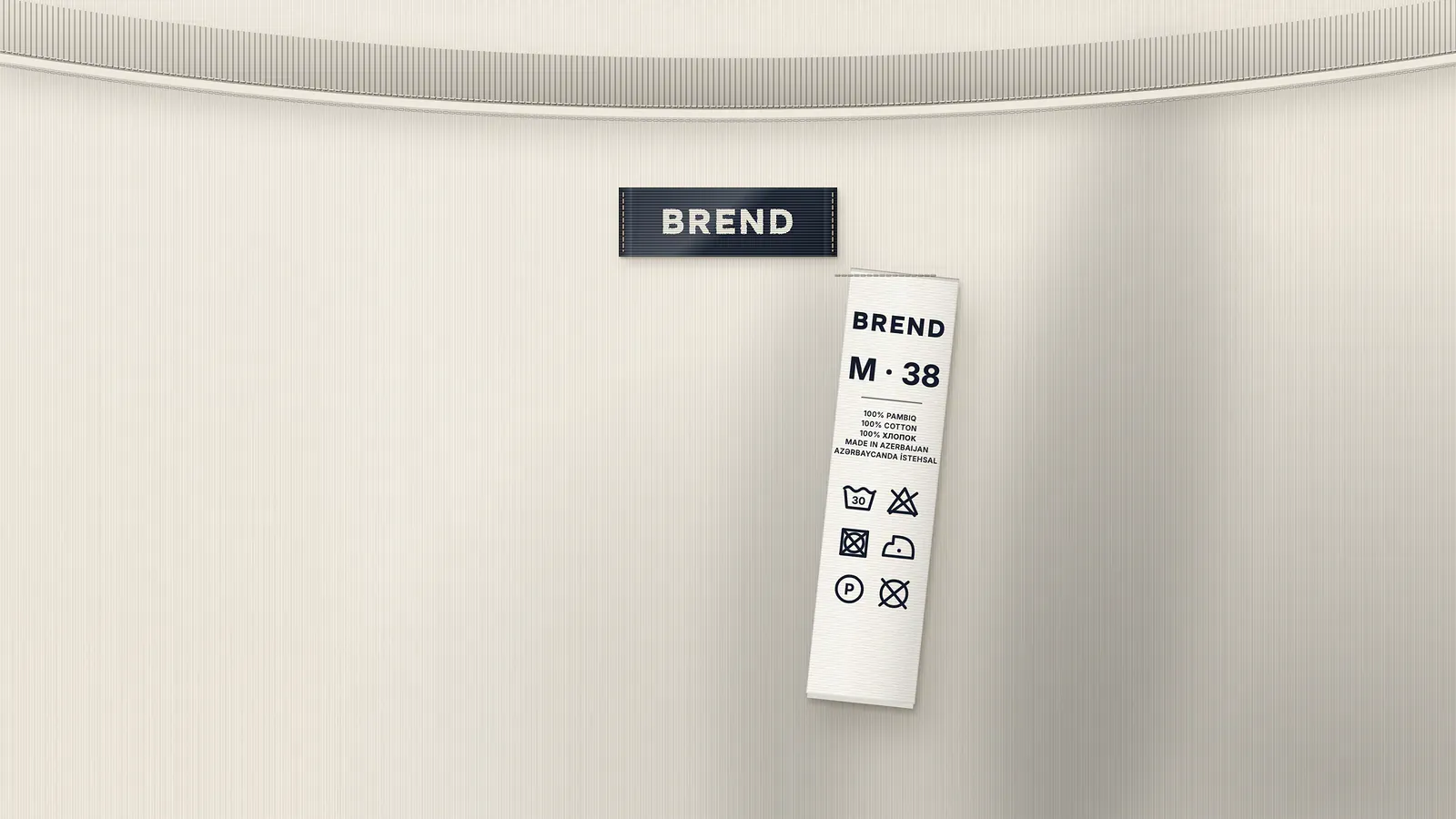
Clothing label requirements share one goal: shoppers should get accurate information about what they buy. A compliant label shows the fiber content, size, country of origin and care instructions. In this guide, we walk through each item and finish with a pre-order checklist.
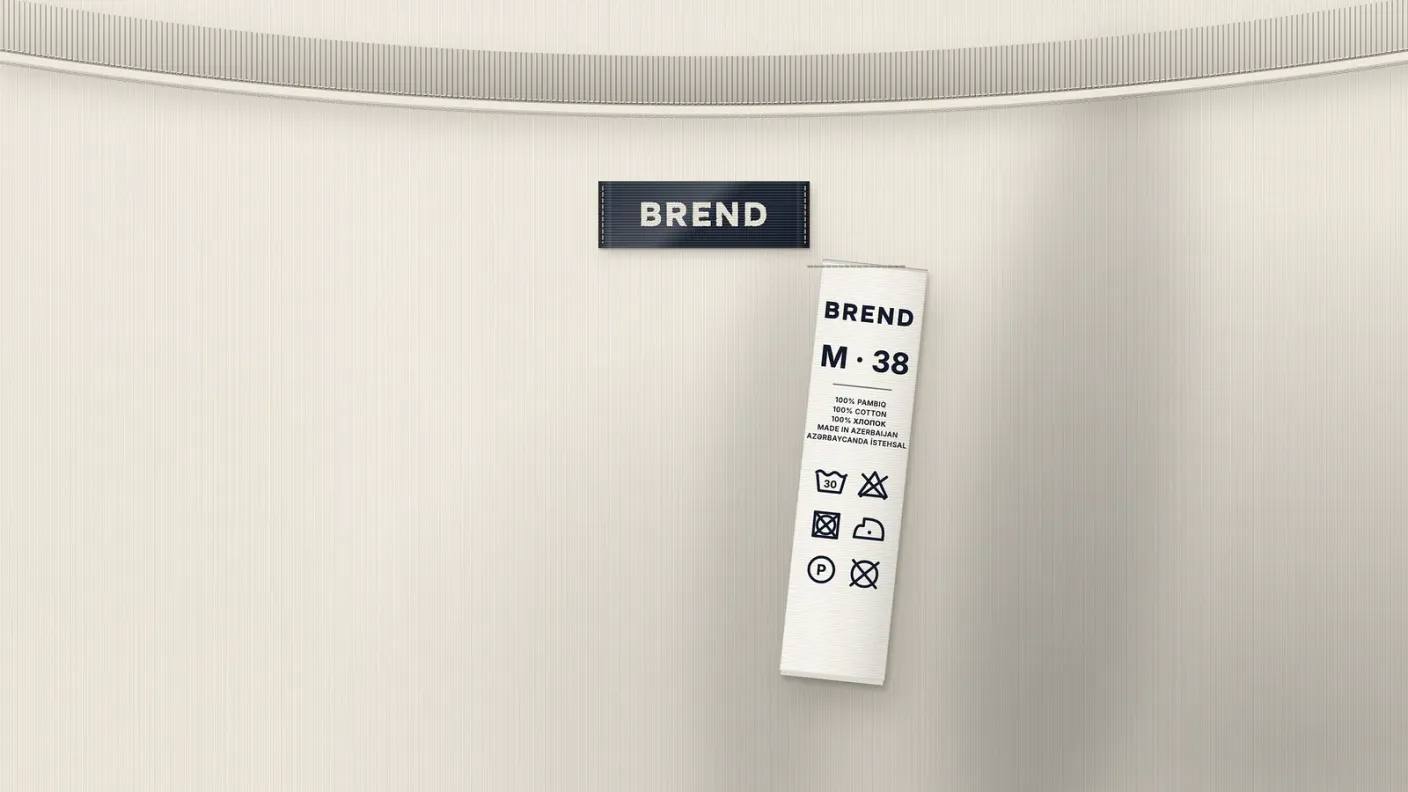
Most brands combine fiber content with care symbols on a single satin or nylon taffeta label. That is why these garment label requirements apply to both composition labels and care labels. You can order both from our Baku office.
What a Composition Label Is
A composition label is the small information label sewn inside a garment. Unlike the brand label, it rarely gets a second look outside the store or the laundry room. Even so, anyone checking a garment against clothing label requirements starts with this label.
In practice, what to put on a clothing label comes down to a short list. It typically covers fiber content and percentages, size, country of origin, the manufacturer or brand, and care symbols. Some markets also ask for the production date, model or batch number.
Fiber Content and Percentages
Fiber content sits at the heart of clothing label requirements. Use generic fiber names such as cotton, polyester, elastane, viscose, wool, linen and polyamide. Then list the percentages by weight, from highest to lowest.
- Correct: 95% cotton, 5% elastane.
- Incorrect: “Cotton-Lycra blend.” It has no percentages, and a brand name replaces the generic fiber name.
- 100%: use it only when the item contains a single fiber.
In the EU, Regulation (EU) No 1007/2011 sets the clothing label requirements for fiber content. It lists standard fiber names and allows a manufacturing tolerance of 3% between the label and the actual content. The Eurasian Economic Union’s technical regulation TR CU 017/2011 allows a deviation of up to ±5%. In the US, the FTC’s rules under the Textile Fiber Products Identification Act also require generic fiber names and percentages.
Linings, Fillings and Non-Textile Parts
If a garment uses several materials, state the content of each one separately, for example “Shell: 100% wool. Lining: 100% viscose.” For jackets, list the filling as well. EU rules add one more garment label requirement. Some products have non-textile parts of animal origin, such as a genuine leather label. In that case, the label must say so with a specific phrase.
Size and Country of Origin
Write the size in a system your buyers know: S, M, L, XL or numbers like 46, 48 and 50. If the size appears on the composition label, each size needs its own label version, even when the content stays the same. Some brands weave the size into the brand label, but then every size needs a separate woven label.
Country of origin usually appears as “Made in Azerbaijan.” Both US and EAEU clothing label requirements treat it as mandatory. In the EU, by contrast, the textile regulation does not currently require it. Many brands still show it voluntarily.
Many markets, including the EAEU, also require the manufacturer’s name and address. In the US, you can use the Registered Identification Number (RN) that the FTC issues instead.
Care Symbols: What to Put on a Clothing Label
Care instructions help shoppers wash a garment without ruining it. TR CU 017/2011 explicitly lists care symbols as part of mandatory clothing marking. In the US, the FTC Care Labeling Rule requires care instructions on most apparel. In Azerbaijan, the consumer protection law also gives buyers the right to complete and accurate information about goods. For shoppers, care instructions are the most practical part of that information.
Show care information with the international ISO 3758 symbols in the standard order: washing, bleaching, drying, ironing and professional cleaning. We explain every icon in our guide to care label symbols. If needed, add a short text after the symbols, such as “Wash inside out.”
Label Language for Clothing Sold in Azerbaijan
Article 7 of Azerbaijan’s Law on the State Language requires the state language on labels of goods produced in the country. This requirement covers clothing labels too. For imported goods, labels and instructions must come with an Azerbaijani translation.
The national antimonopoly and consumer market authority also monitors Azerbaijani-language information on the labels of imported non-food goods. In practice, then, Azerbaijani should be the main language on any label for the local market.
If you export, add the language of your target market. For EAEU countries such as Russia and Kazakhstan, TR CU 017/2011 requires Russian or the local state language. In the EU, the label must use the official language of the member state where you sell the product. On multilingual labels for the local market, we recommend putting the Azerbaijani text first.
Placement and Permanence: Garment Label Requirements
A composition label must stay on the garment and remain legible for its whole life. Under EU clothing label requirements, labels must also be durable, easily legible, visible and accessible. That is why sewing beats gluing for this type of label.
Most brands sew the label into a side seam, the waistband or below the back neck. In the US, garments with a neck must show the country of origin on the inside center of the neck. In underwear and babywear, place the label where it touches the skin least.
When choosing the material, keep these points in mind:
- English satin: soft and flexible, ideal for underwear and babywear.
- Nylon taffeta (“Japanese akmaz”): feels like paper but handles heat, water and detergents better.
- Print quality: the text must stay legible after many washes, so wash a sample before a large run.
Pre-Order Checklist
Before you approve the proof, check your design against these clothing label requirements with your production team:
- Fiber names and percentages are correct and add up to 100%.
- You have listed the lining, filling and other parts separately.
- Each size has its own label version.
- The label shows the country of origin and the manufacturer or brand.
- The care symbols suit the fabric and follow the standard order.
- The text appears in Azerbaijani and in any languages you need for export.
- The label material and size suit the sewing position.
- You have printed the proof at 100% scale and checked legibility.
Order Composition and Care Labels
Etiket.az has made labels for clothing manufacturers in Azerbaijan since 2014. You send the fiber content, sizes and symbols, and we prepare the proof for your approval. During our free design consultation, we also discuss layout and material with you. At the proof stage, we go through these clothing label requirements together. The final compliance call stays with your brand.
Launching a new brand? See what goes into a full kit on our clothing brand labels page. Every label type is in our clothing labels range.
Step 1: Prepare the text
Send the fiber content, sizes, country of origin and symbols in one file.
Step 2: Get a quote
On business days, we reply within 24 hours with a price and a material recommendation.
Step 3: Check the proof
Together we review the text in every language and the symbol order.
Step 4: Collect your labels
After approval, we start production and hand over the finished order in Baku.
Garment Label Requirements: FAQ
Is the fiber percentage mandatory?
Which language must the label use?
Where should I sew the care label?
Can fiber content and care instructions share one label?
How do I find out the exact fiber percentages?
Can I put the size on the composition label?
Order Labels That Check Every Box
Send us your fiber content and care symbols, and we will prepare the proof. You get a quote within 24 hours on business days.
Related product
Care Labels for Clothing: Satin and Nylon Taffeta
Want to order the label discussed in this article?