Blog
Care Label Symbols Explained
Washing, bleaching, drying, ironing and professional cleaning icons, the correct order on a label, and a printable chart.
Etiket.az team 8 min read
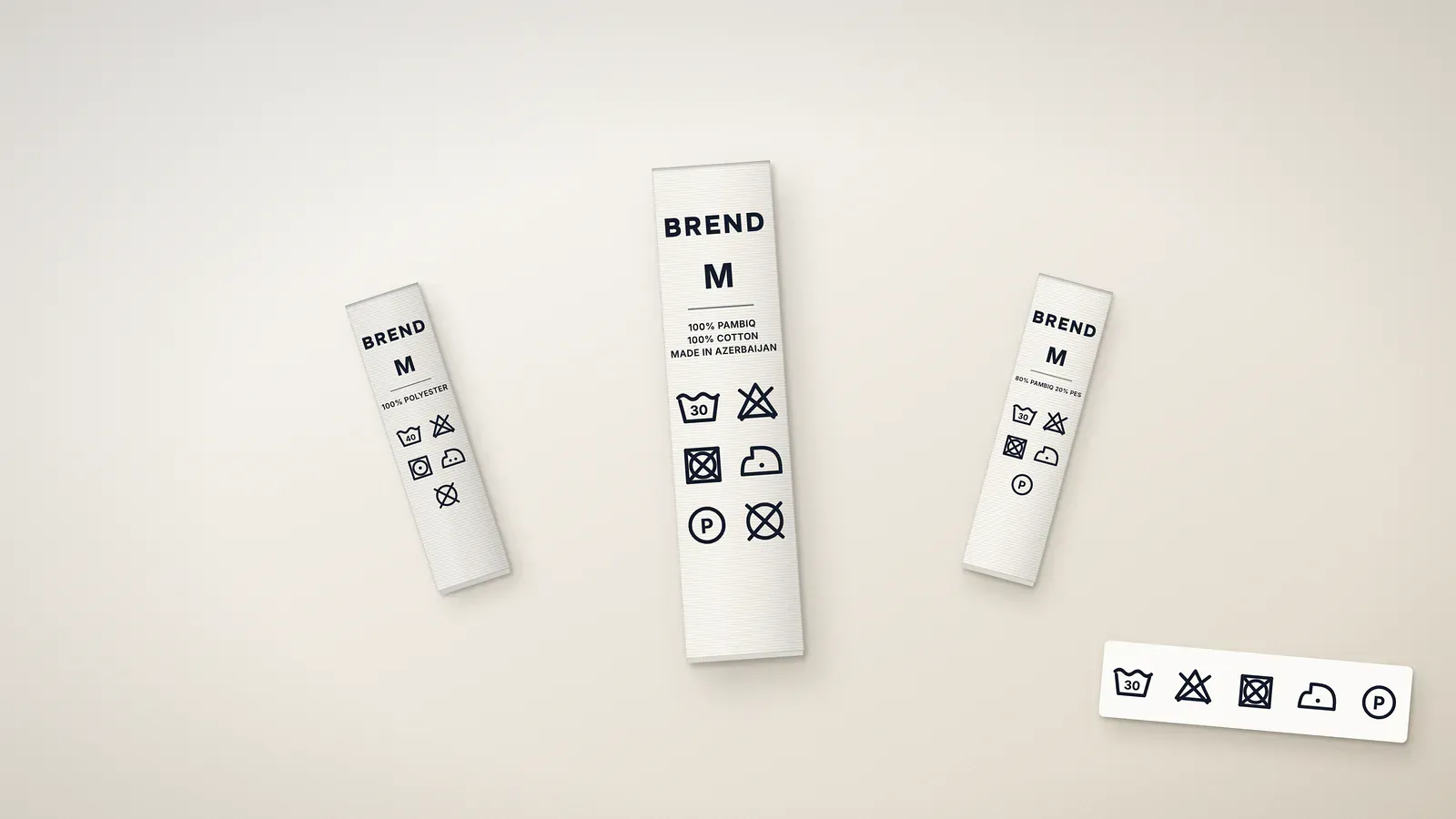
Care label symbols use five basic shapes to show how to look after a garment. The washtub covers washing, the triangle bleaching, the square drying, the iron ironing and the circle professional cleaning. Numbers and dots set the temperature, bars underneath call for a gentler cycle, and a cross means “don’t.”
This guide explains every common symbol, shows the correct order on a label and ends with a printable chart. Need labels for your own collection? Our Baku team prepares custom care labels and helps you lay out the symbols.
Why Care Label Symbols Matter
Shoppers wash clothes at home and trust the label alone. If it shows the wrong temperature, a cotton T-shirt can shrink and a wool sweater can lose its shape. The customer then blames the brand, and the store handles a return.
That is why factory-made clothing almost always carries a care label. Manufacturers usually sew it into a side seam or below the back neckline, right against the skin. So the label has to be soft, durable and readable without translation.
The international system rests on ISO 3758, whose fourth edition came out in 2023 and replaced the 2012 version. In addition, the international association GINETEX owns the symbols as registered trademarks. It also sets the rules for their correct use.
The Five Basic Wash Care Symbols
Numbers, dots and bars refine each of the five shapes, so one shape can carry several meanings.
| Symbol | What it controls | Key variations |
|---|---|---|
| Washtub | Washing | Number = maximum temperature, bar = gentle cycle, hand = hand wash |
| Triangle | Bleaching | Empty = any bleach, two diagonal lines = non-chlorine bleach only |
| Square | Drying | Circle inside = tumble drying, lines = natural drying |
| Iron | Ironing | One, two or three dots = soleplate temperature |
| Circle | Professional cleaning | P or F = dry cleaning, W = professional wet cleaning |
The general rule is simple: a cross over any symbol means “do not.” More dots mean more heat, while more bars mean a gentler process.
Washing Symbols: The Tub
The tub covers machine and hand washing. The number inside shows the maximum water temperature in degrees Celsius. For example, a tub with 30 means water no hotter than 30 °C (86 °F).
- 30, 40, 60 or 95: machine wash at or below that temperature.
- One bar under the tub: gentle cycle with less agitation, typically for synthetics.
- Two bars: very gentle cycle, usually for wool and delicate fabrics.
- Hand in the tub: hand wash only, normally in water no warmer than 40 °C.
- Crossed-out tub: do not wash in water.
Note that US labels that follow ASTM D5489 often use dots instead of numbers. There, one dot means about 30 °C, two dots 40 °C and three dots 50 °C. So check which wash care symbols an imported garment uses before you wash it.
Bleaching Symbols: The Triangle
The triangle tells you whether bleach is safe. Chlorine can strip color and damage wool, silk or spandex. Check it especially on whites and light colors.
- Empty triangle: any bleach, including chlorine bleach.
- Triangle with two diagonal lines: oxygen-based, non-chlorine bleach only.
- Crossed-out triangle: do not bleach. Use a detergent without bleaching agents.
Older labels sometimes show “Cl” inside the triangle, which allowed chlorine bleach. However, the modern ISO system replaced it with the empty triangle.
Drying Symbols: The Square
The square explains how to dry an item after washing. On a care label, these symbols come in two groups: tumble drying and natural drying.
Tumble Drying
- Circle inside a square: tumble drying is fine.
- One dot in the circle: tumble dry on low heat.
- Two dots: tumble dry at normal heat.
- Crossed-out square with circle: do not tumble dry, because the fabric may shrink or warp.
Natural Drying
- Vertical line in a square: hang to dry on a line or hanger.
- Two vertical lines: drip dry, so hang it wet without wringing or spinning.
- Horizontal line: dry flat, which matters most for knitwear and wool.
- Diagonal line in the corner: dry in the shade, since sunlight can fade colors.
Ironing Symbols and Temperatures
Ironing is the easiest part of reading care label symbols, because it all comes down to the number of dots. They set the maximum soleplate temperature, and the rule applies to both dry and steam irons.
- One dot: up to 110 °C (230 °F) for acrylic, nylon and acetate. Steam can damage these fibers.
- Two dots: up to 150 °C (300 °F) for wool, silk, polyester and viscose.
- Three dots: up to 200 °C (390 °F) for cotton and linen.
- Crossed-out iron: do not iron.
Some labels also show crossed-out steam lines under the iron, which means you should iron without steam. For blends such as cotton and polyester, always pick the temperature of the most sensitive fiber.
Professional Cleaning Symbols: The Circle
Circle symbols speak mainly to dry cleaners. For shoppers, the message is simple: if you see one, a professional cleaner is the safer choice.
- P: professional dry cleaning in tetrachloroethylene and all solvents listed for F.
- F: professional dry cleaning in hydrocarbon solvents only.
- W: professional wet cleaning, a gentle water-based process on special equipment.
- Bar under the circle: mild process. Two bars mean a very mild one.
- Crossed-out circle: do not dry clean.
You may still see an “A” on older labels, which once allowed any solvent. However, the current ISO edition no longer includes it, so compare old care label symbols with an up-to-date chart.
How to Arrange Symbols on a Care Label
Brands should not place the symbols at random. The standard sets one order for the five groups, from left to right:
- Washing (tub)
- Bleaching (triangle)
- Drying (square)
- Ironing (iron)
- Professional cleaning (circle)
A fixed order lets shoppers find the right icon in seconds. In addition, care label symbols usually sit next to or below the fiber content. For the rest of the information a garment needs, read our guide to clothing label requirements.
Practical Tips for Clothing Brands
- Choose symbols based on the fabric content and your supplier’s care advice.
- With mixed materials, follow the most delicate one, such as the lining or an appliqué.
- Print the proof at 100% scale to check that the icons are legible.
- Show all five groups as a rule, since a “do not” is useful information too.
Printable Laundry Symbols Guide
The chart below lists the symbols we see most often on labels. Print it and keep it in your sewing room or warehouse.
| Symbol | Meaning |
|---|---|
| 30 in a tub | Machine wash up to 30 °C |
| 40 in a tub with one bar | Gentle cycle up to 40 °C |
| 30 in a tub with two bars | Very gentle cycle up to 30 °C |
| Hand in a tub | Hand wash only |
| Crossed-out tub | Do not wash |
| Empty triangle | Any bleach |
| Triangle with two lines | Non-chlorine bleach only |
| Crossed-out triangle | Do not bleach |
| Circle in a square with one dot | Tumble dry on low heat |
| Crossed-out square with circle | Do not tumble dry |
| Horizontal line in a square | Dry flat |
| Iron with one dot | Iron up to 110 °C |
| Iron with three dots | Iron up to 200 °C |
| P in a circle | Professional dry cleaning |
| Crossed-out circle | Do not dry clean |
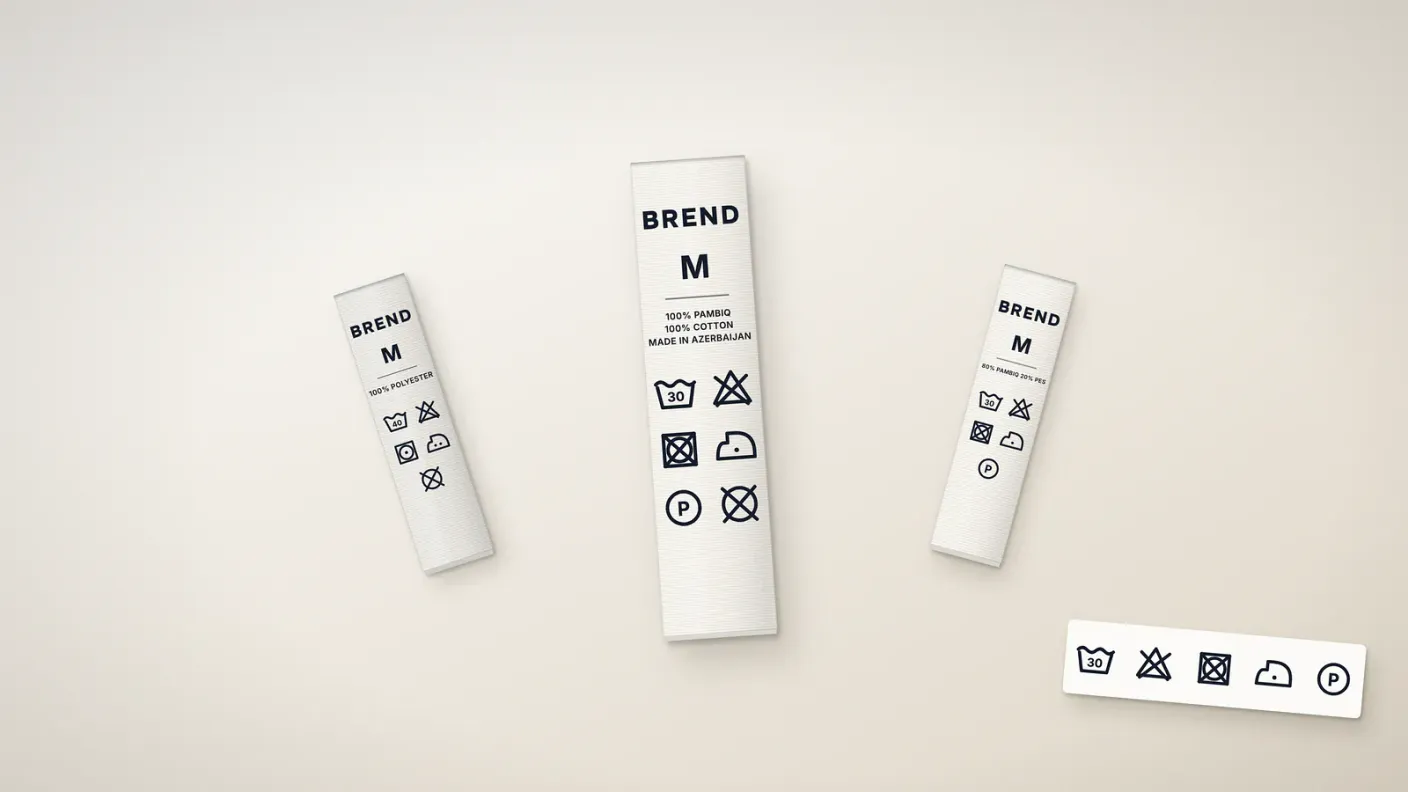
Order Custom Care Labels
Etiket.az has made labels for clothing manufacturers since 2014. For care labels we offer two materials: nylon taffeta, known locally as “Japanese akmaz,” and English satin. Taffeta feels a bit like paper but is far tougher and handles water, heat and detergents well. Satin is soft, thin and flexible, so it feels comfortable in underwear and babywear.
You send the fiber content, the wash care symbols you need and your logo. We then prepare the proof and agree on the layout together. For a branded neck label, see our woven labels, and for the full range, visit clothing labels.
Step 1: Send your details
List the fiber content, symbols, label size and quantity. Vector logos (AI, PDF, EPS or SVG) work best.
Step 2: Get a quote
On business days we reply within 24 hours with a quote and a material recommendation.
Step 3: Approve the proof
Together we check the order of the wash care symbols and the legibility of small text.
Step 4: Production and handover
Once you approve, we produce the labels and hand the order over in Baku.
Care Symbols Meaning: FAQ
Are care symbols an international standard?
In what order should the symbols go?
How do I use the symbols on my own label?
What does a cross over a symbol mean?
What do the dots on the iron and dryer symbols mean?
Will the print on a care label wash off?
Get Care Labels for Your Collection
Send us the fiber content and the wash care symbols you need, and we will prepare the proof. On business days, the quote follows within 24 hours.
Related product
Care Labels for Clothing: Satin and Nylon Taffeta
Want to order the label discussed in this article?