Blog
Food Label Requirements in Azerbaijan
What Article 17 of the law demands, how to show allergens and dates, plus a pre-press checklist for producers.
Etiket.az team 9 min read
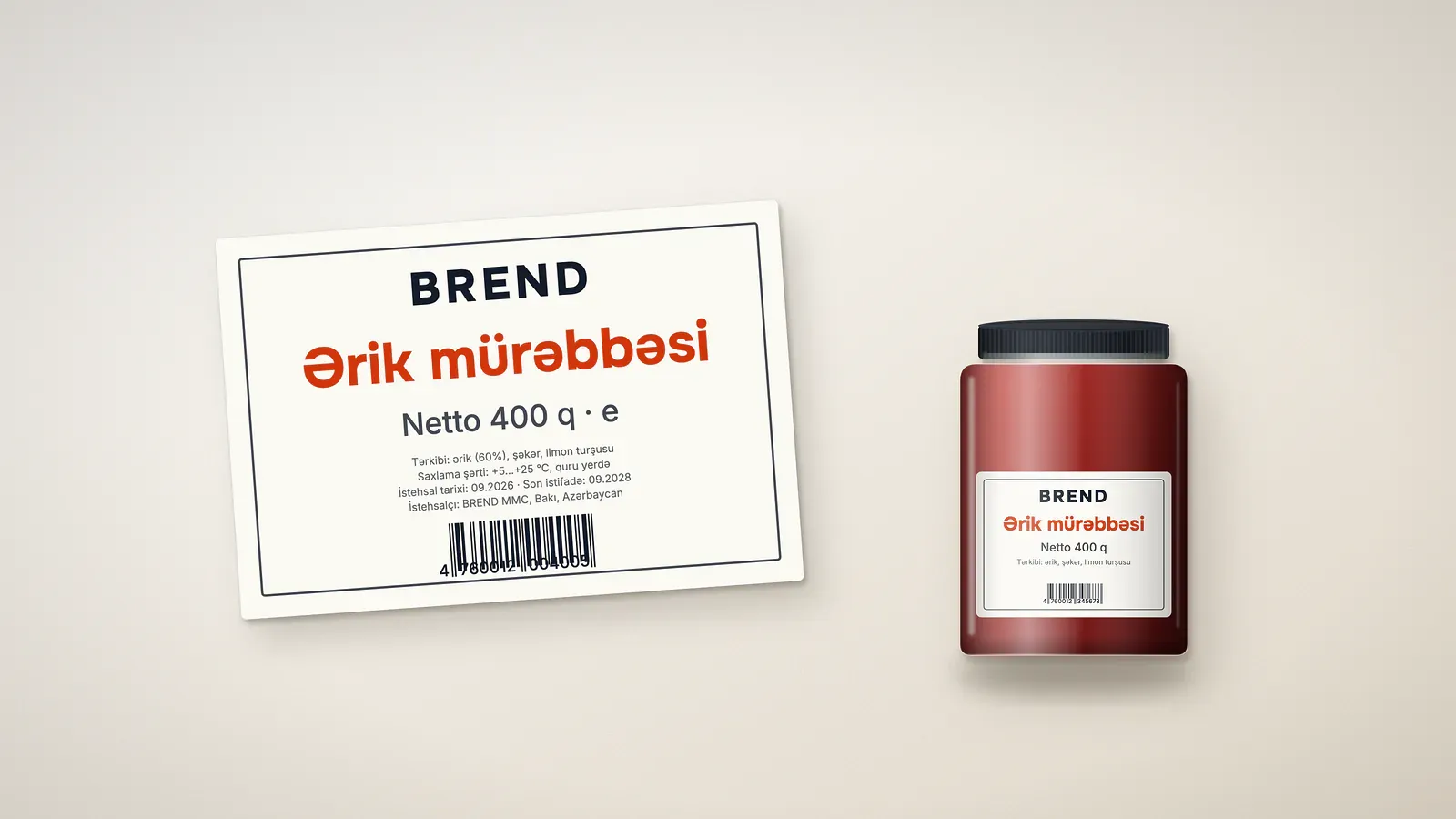
Food label requirements in Azerbaijan come down to one simple idea. Shoppers must know what the product is, what it contains and how long it stays safe. The legal basis is the Law of the Republic of Azerbaijan on Food Safety, No. 523-VIQ of May 5, 2022. Under Article 17, a label must give the product name, ingredients, quantity, dates, storage conditions, allergens and producer details. In addition, it must be accurate, clear and understandable.
Etiket.az has been making labels in Baku since 2014, and we work with producers' artwork every day. Below you will find the mandatory details, common mistakes and a pre-press checklist. Ready to print? See materials and formats on our food labels page. However, this guide is not legal advice: the producer remains responsible for the label text.
Why food labeling in Azerbaijan is regulated
The label is the main direct line between a producer and a shopper. For example, a person with a peanut allergy must read the ingredients before buying. The law also bans claiming properties a product does not have. In other words, you cannot call a yogurt without strawberries a “strawberry” yogurt.
What to put on a food label
Article 17.2.1 of the law holds the core of the food label requirements: it lists what a label must tell the consumer. The table below adds our practical notes.
| Information | What to watch |
|---|---|
| Product name | The real product type, not just the brand: “cherry jam” |
| Ingredients | In descending order by weight, including food additives |
| Allergens | Highlighted so they stand out in the ingredient list |
| Nutrition and energy value | Usually per 100 g or 100 ml: energy, protein, fat, carbohydrate |
| Quantity | Net weight or volume: g, kg, ml, l |
| Production date and shelf life | An unambiguous day, month and year |
| Storage conditions | Temperature, humidity, storage after opening |
| Origin, producer name and address | Country, full company name and address |
| Production method and instructions for use | Preparation or usage instructions where needed |
| Quality indicators | Type-specific indicators, such as fat content |
Article 17.5 leaves the detailed rules to technical regulations on food safety, so baby food or dietary supplements may face stricter conditions. The full text of the law, in Azerbaijani, is in the FAO's FAOLEX database.
Product name and ingredients
The name has to reflect the true nature of the food. A brand name alone is not enough, so add a plain description such as “cottage cheese”. Then come the ingredients. The international Codex Alimentarius standard calls for listing them in descending order of weight at the time of manufacture. For example, if a jam contains more fruit than sugar, fruit opens the list.
Food additives and compound ingredients
If you use preservatives, colors or emulsifiers, include them too. Producers usually pair the additive's function with its name, for example “preservative: potassium sorbate”. Also, break down compound ingredients, such as chocolate chips, in parentheses. As a result, shoppers see every substance in one list.
Net quantity and expiry date on the label
State the net quantity in metric units: grams or kilograms for solids, milliliters or liters for liquids. For foods in brine or syrup, international practice also shows the drained weight. That way, shoppers know how much food is actually in the jar.
Use-by date versus best-before date
Dates are a core part of food label requirements: the law asks for both the production date and the shelf life. In practice, you will see two phrases. A use-by date applies to perishable foods, and eating them after that date can be unsafe. A best-before date, on the other hand, is about quality. For example, cookies may lose their crunch after it but usually stay safe to eat.
Shoppers look for the expiry date first, so print it as day, month and year, for example 15.03.2027. Producers often add the date and lot number on the packing line with an inkjet coder. For this reason, we reserve a blank area for the date. Some varnishes weaken coder ink adhesion, so we match that area's finish to your coder. A lot number is not on the law's list, but it makes recalls easier.
Producer, origin and storage conditions
The label must name the producer, give its full address and state the product's origin. For imports, Article 17.4 requires an Azerbaijani translation of any foreign-language label, ingredient list, shelf-life details and instructions. Importers usually meet this rule with a translation sticker. Interestingly, the law treats sticker text as a form of labeling too.
Write storage conditions in concrete terms: “store at +2 °C to +6 °C” helps more than “store in a cool place”. Also state how many days the product keeps after opening. As a result, customers store it correctly, and you get fewer quality complaints.
Food label requirements for allergens and nutrition
The law separately requires the label to show allergens present in the product. It does not list them, so international lists make a handy reference. EU rules, for example, name 14 major allergens: cereals containing gluten, crustaceans, eggs, fish, peanuts, soybeans, milk, tree nuts, celery, mustard, sesame, sulfur dioxide and sulfites, lupin and mollusks.
Producers usually highlight allergens in the ingredient list with bold type or a different color. That way, shoppers spot them at a glance. If your line carries a cross-contamination risk, many producers also add a warning such as “may contain traces of peanuts”.
Nutrition and energy value are on the law's list as well. Producers usually give energy in kcal and kJ per 100 g or 100 ml, plus protein, fat and carbohydrate. A table works best, because it stays tidy even on a small label.
Language and legibility
Language is part of the food label requirements too. Under Article 17.2.2, labeling must be accurate, clear and fully understandable. For products sold in Azerbaijan, the main text must be in Azerbaijani, and Russian or English can sit alongside it. On a multilingual label, give each language its own block.
Legibility is not only about language. Dark text on a light background and a plain typeface help a lot. The law itself sets no font size, but the EU requires a minimum x-height of 1.2 mm for mandatory text. Even without exports, it is a useful benchmark. Also, keep text away from seams and folds.
Where to check food labeling rules in Azerbaijan
The Azerbaijan Food Safety Agency (AFSA, known locally as AQTA) oversees food safety in the country. Its website hosts an explainer on food labels in Azerbaijani. For the current wording of laws, search the official legal database e-qanun.az.
If you plan to export, also check the importing country's rules: Regulation (EU) No 1169/2011 in the EU or technical regulation TR CU 022/2011 in the EAEU. For a new product, the safest step is a review by a lawyer who knows food law. We, in turn, check the technical side: size, legibility and materials.
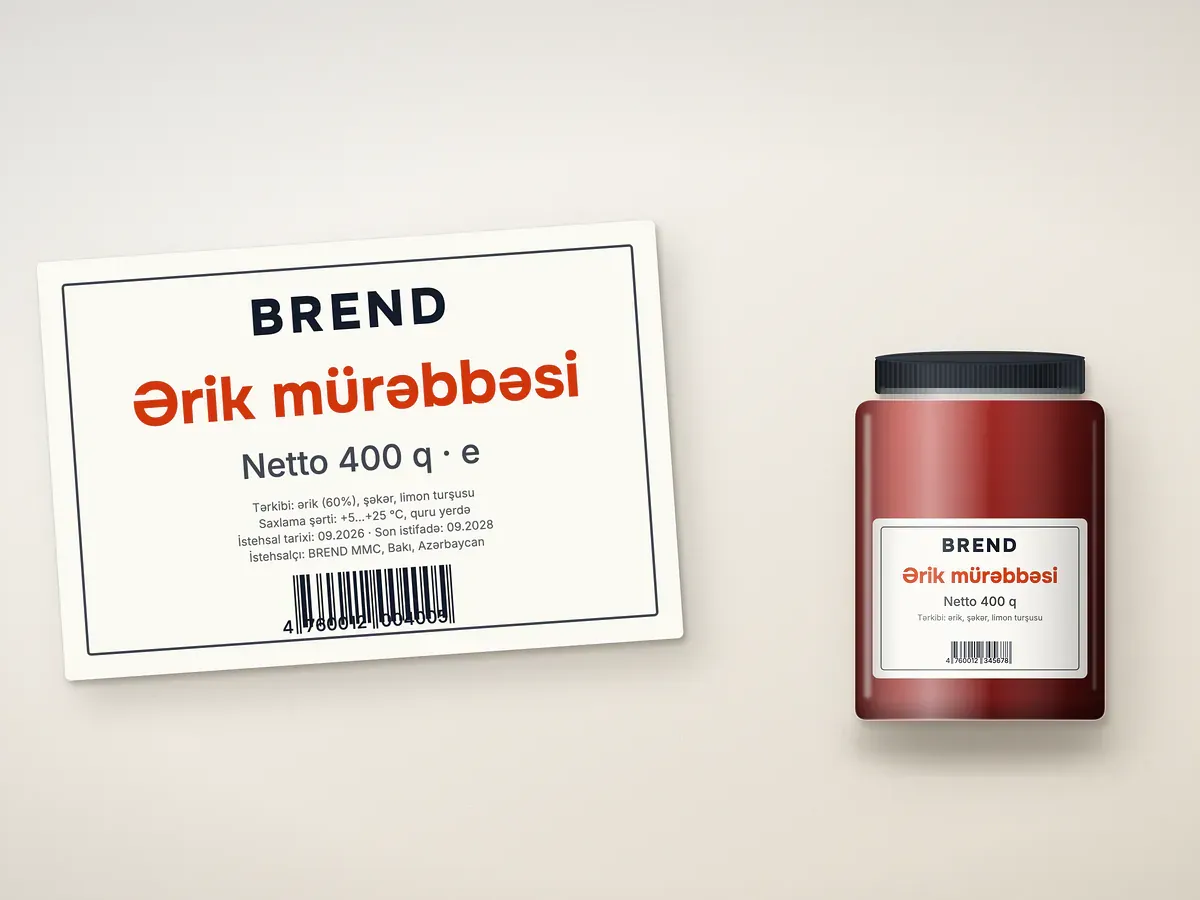
Food label checklist before printing
Run through this list before you send artwork to print. If you can answer “yes” to every point, your label meets the core food label requirements:
- The name shows the real product type
- Ingredients appear in descending order by weight, with allergens in bold
- Net weight or volume uses metric units
- Space for the production date, shelf life and lot number
- Storage conditions and the after-opening period are specific
- The producer's name, address and country of origin are complete
- Nutrition values refer to 100 g or 100 ml
- The main text is in Azerbaijani and translations are accurate
- Dark text on a light background reads easily
If you supply retail chains, your pack also needs an EAN-13 barcode on a white background with clear margins. Our barcode guide explains where to get the number.
Food label printing: how we help
You approve the content, and we make sure it prints sharp and legible. With the food label requirements in mind, we reserve space for ingredients, dates and the barcode from the start. For example, we offer moisture-resistant film for chilled products and freezer-grade adhesive for frozen ones. For automatic labelers, we wind roll labels on the core size your machine needs. Our food and beverage labels page covers the whole sector.
Step 1: Artwork and details
Send artwork or text, container size and storage conditions.
Step 2: Check and quote
We check the file and quote within 24 hours on business days.
Step 3: Approval
Next, we agree on material, size and colors, then send the final proof.
Step 4: Print and handover
Finally, we print the run and arrange the handover in Baku.
Food label requirements: FAQ
Must food labels be in Azerbaijani?
How should allergens be shown?
Where can I find the official requirements?
Can you print the expiry date together with the label?
Do you print translation stickers for imported food?
Get a quote for your food labels
Send artwork, size and quantity, and get a proposal within 24 hours on business days.
Related product
Custom Food Labels
Want to order the label discussed in this article?